



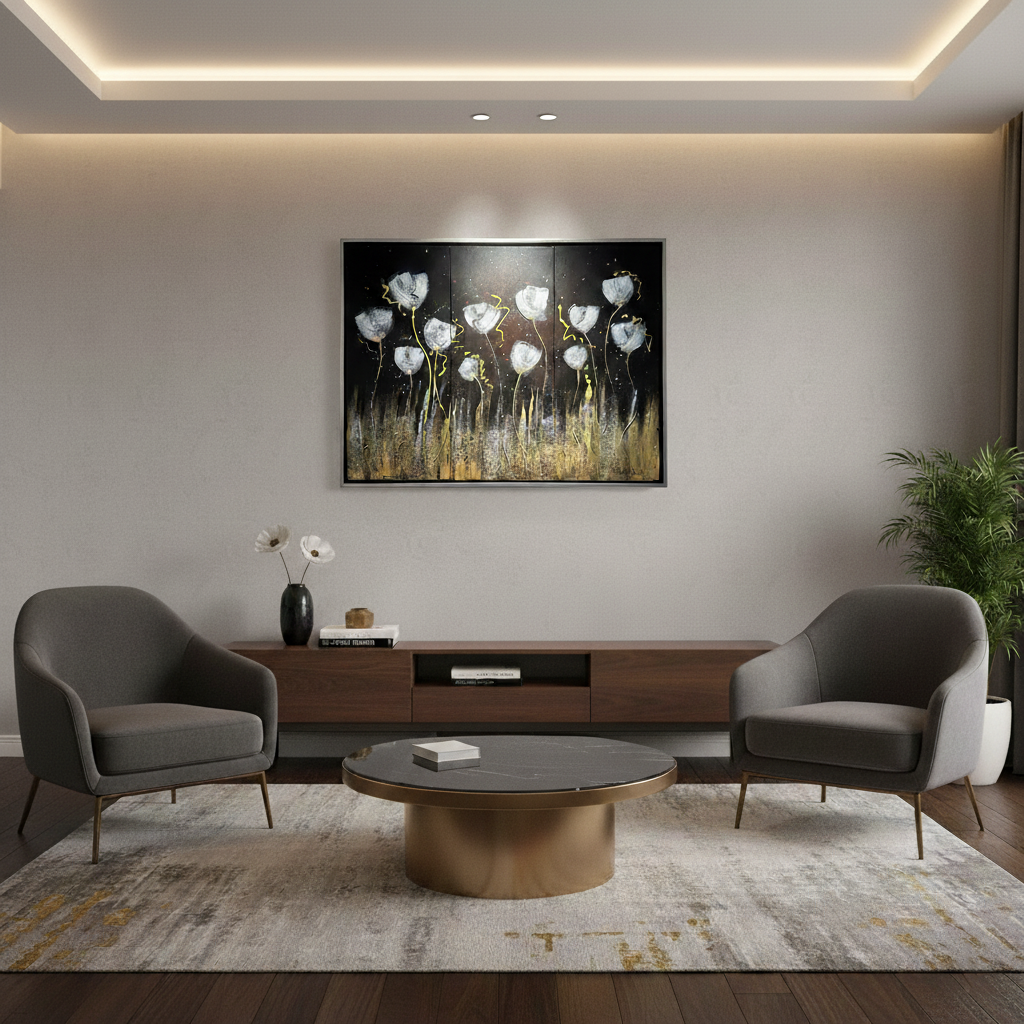
Art on the Wall: How Paintings Transform a Living Space
 Apr 28, 2026
A home is never defined by furniture alone.
It is the layers beyond function — texture, light, and art — that give a space its depth and identity.
Among these, wall art holds a unique role. Not as decoration, but as presence.
More Than Decoration: Creating a Focal Point
In a well-composed interior, every space benefits from a moment of focus.
A painting naturally draws the eye, anchoring the room without overwhelming it. Whether placed above a sofa, along a hallway, or within a dining area, it introduces a visual centre — something the space quietly orbits around.
Unlike furniture, which serves a purpose, art exists purely to be experienced.
And in doing so, it elevates everything around it.
Defining Atmosphere Through Art
The mood of a space is often shaped by what is seen first.
A large-scale abstract piece can introduce calm through muted tones and fluid forms. A bold composition adds energy and contrast. Softer works bring warmth and subtlety.
Rather than changing the entire interior, a single painting has the ability to shift the emotional tone of a room — making it feel more serene, more expressive, or more refined.
Adding Depth and Dimension
Flat surfaces can make a space feel incomplete.
Wall art introduces visual layering — breaking up large expanses and adding dimension where it is needed most. When paired with lighting, the effect becomes even more pronounced.
A carefully placed light can highlight textures, brushstrokes, or material finishes, allowing the artwork to interact with its surroundings throughout the day.
A Reflection of Personal Identity
Perhaps the most compelling reason to incorporate art is its ability to reflect individuality.
Unlike furniture, which often follows functional requirements, art is deeply personal. It speaks to taste, memory, and perspective.
A home curated with artwork feels lived-in, not staged — shaped by choices that go beyond necessity.
Balancing Art with Space
In refined interiors, how art is placed matters as much as the artwork itself.
Proportion, spacing, and alignment all contribute to a sense of harmony. A single oversized piece can feel intentional and bold, while a series of smaller works can create rhythm and continuity.
Equally important is restraint — allowing the artwork enough space to breathe, ensuring it remains a focal point rather than becoming visual clutter.
Completing the Interior
Without art, a space may feel functional, even beautiful — but rarely complete.
Wall art introduces the final layer. It softens structure, adds narrative, and brings a sense of cohesion to the overall design.
It is not an addition, but a completion.
Living with Art
To live with art is to engage with it daily — in passing moments, shifting light, and changing perspectives.
Over time, it becomes part of the home’s rhythm, quietly influencing how the space is experienced.
And in that presence, a house begins to feel distinctly, unmistakably personal.
